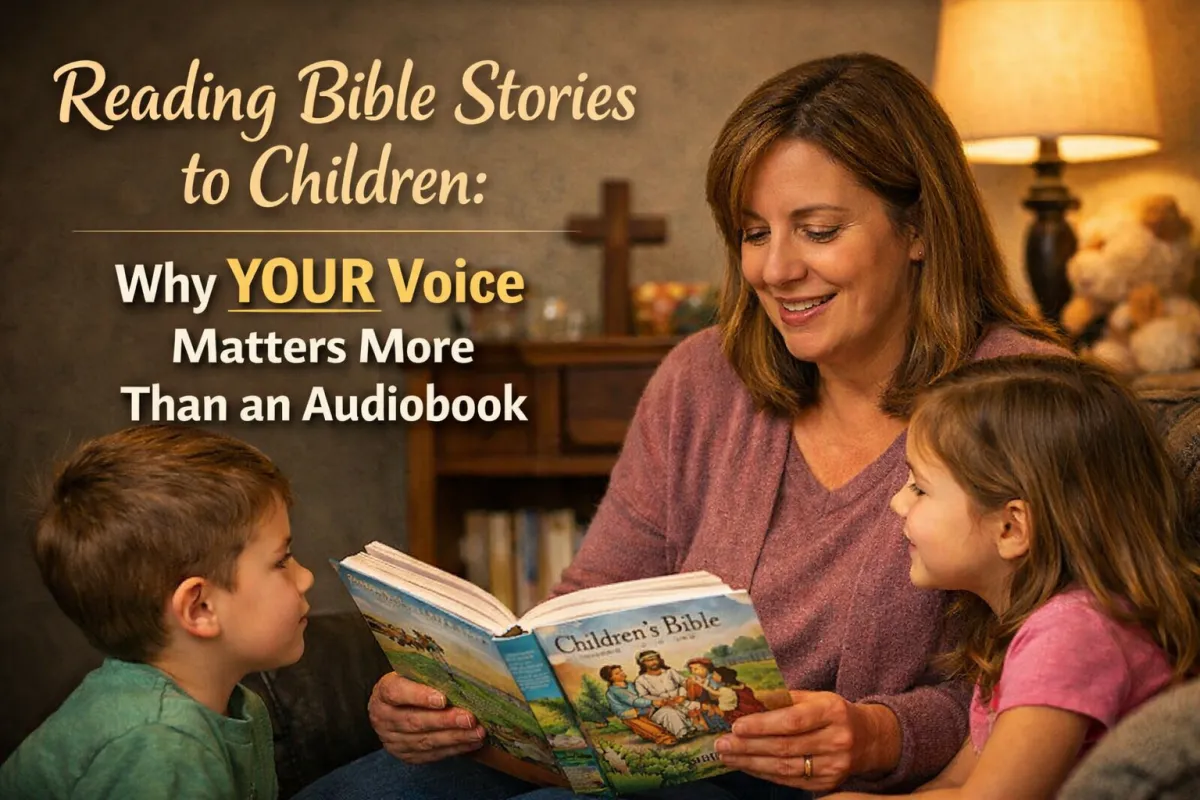
Reading to Children
Why Children Need You to Read Bible Stories—Not Just a Voice from a Speaker
We live in a world where almost everything can be played, streamed, or asked to read itself aloud. Audiobooks are convenient, polished, and always available. And for many things, they’re perfectly fine.
But when it comes to children—and especially children’s Bible stories—convenience is not the same as connection.
I believe something vital is lost when a child’s first encounters with Scripture come from a voice they do not know.
A familiar voice does more than read words
When a child hears a Bible story read by a parent, grandparent, or trusted adult, something deeper happens than simple listening. That familiar voice carries safety. It carries tone, pauses, warmth, and emotion that no professional narrator—no matter how skilled—can replace.
A child doesn’t just hear the story.
They feel it.
They sense when a moment is serious, when something is gentle, when a lesson matters. They watch your face. They hear concern, reassurance, joy, or sadness in your voice. That is how meaning settles into a child’s heart.
A recording can read the words.
A trusted adult gives them weight.
Understanding grows through presence, not perfection
Children don’t process Bible stories the way adults do. They stop you mid-sentence. They ask questions that feel sideways. They notice details you didn’t think mattered.
“What does that mean?”
“Why did they do that?”
“Was God mad?”
Those questions don’t come up naturally with an audiobook playing in the background. But they appear quickly when a child feels safe interrupting someone they love.
And that’s where real understanding begins—not in perfectly delivered narration, but in imperfect, meaningful conversation.
Faith is learned through relationship
Children learn what matters by watching what we give our time and attention to. When you sit down and read to a child, you are quietly telling them:
“This story matters.”
“You matter.”
“I’m here with you.”
That moment teaches more than the story itself. It teaches that faith is personal. That Scripture isn’t something distant or mechanical. It’s something shared—handed down through relationship.
A voice from a device cannot model that.
Technology has a place—but it shouldn’t replace us
This isn’t about rejecting technology. Audiobooks can be helpful supplements, especially for older children or independent reading time. But they should never replace the human connection that makes these stories come alive in the first place.
Children don’t need flawless storytelling.
They need present storytelling.
They need to hear Scripture wrapped in love, patience, and familiarity. They need to know that these stories are important enough for someone they trust to sit down and read them aloud.
The message is carried by the messenger
Bible stories are not just lessons. They are foundations—about trust, fear, obedience, patience, and hope. When those messages come through a trusted adult, they land differently. They feel safer. They feel real.
And years later, when children remember these stories, they won’t remember the exact words.
They’ll remember you reading them.
And that may be the most important message of all.
